The Ctrl + C Mindset and the Illusion of a Quick Start
There is a pattern most of us remember from our school days: required reading wasn’t actually read – it was copied. From a better student, from study guides, from the internet – the source didn’t matter. What mattered was having something good enough to pass.
That model could function as long as the worst possible outcome was a bad grade. The problem begins when this mindset moves into a production process that is no longer a hobby, but manufacturing with the intention of selling a finished product.
When Speed Becomes the Priority
Candle making is one of those fields. In recent years, candles have become a highly sought-after product, and sales across the EU amount to multi-million-euro figures. It is therefore not surprising that an increasing number of people see candle making primarily as an opportunity for quick profit.
Unfortunately, the market is saturated with handmade candles whose primary goal is to look attractive and capture attention by following visual trends. In such an environment, speed becomes a value in itself – produce faster, post faster, sell faster. Testing and safety verification then become a formality, if they are conducted at all.
The Search for a One-Stop Shop
A recurring question in hobby groups on social media sounds reasonable: I’ve just started making candles, tell me where can I find all the necessary information in one place?
Although sincere in its naivety, the question is flawed in its expectations. Instructions are sought the same way school assignments were once copied – to skip the process and arrive at the result. The logic is simple: a recipe that “works” can be repeated; what can be repeated can be produced in larger quantities and sold. In this context, learning is replaced by copying.
It is interesting to observe the responses to such beginner questions. Some immediately offer a solution in the form of a course or workshop, thereby reinforcing the assumption that there is a “place” where you can get everything. Others respond with brief statements such as, “Everything is described for each wax.” At best, this is a half-truth. Technical product data is not the same as the result achieved when wax is mixed with fragrance oil and the candle is burned under real conditions. Less common are responses that shift the focus from ready-made solutions to the process itself. They may not be popular, but they offer something more valuable – realistic expectations.
AI as an Additional Driver of Illusion
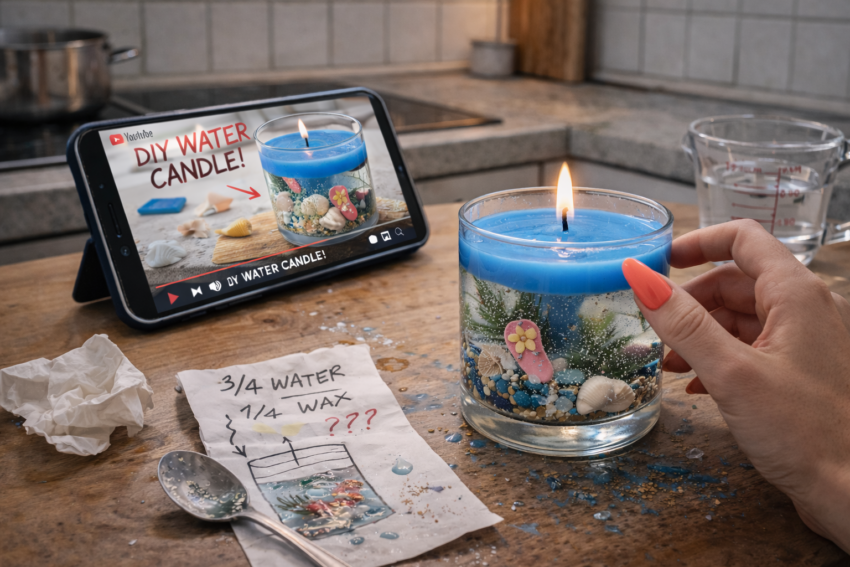
Since AI-generated images have flooded the internet and are widely used in promoting silicone molds, this Ctrl + C behavioral pattern has gained an additional, unrealistic boost. Such images are an illusion; they do not follow the laws of physics or the material limitations of the candles they supposedly depict.
If you have never made a candle before, setting such an illusion as the expected result means starting from an unrealistic point of departure – while expecting a realistic outcome.
It is like tasting an exceptional traditional dish once and then attempting to recreate it without a recipe, without experience, and without quality ingredients – relying only on memory and an AI-generated recipe. The result will not match expectations, not because the necessary skill cannot be acquired, but because the goal itself is unrealistic.
The Limits of Shortcuts
Courses can be a useful starting point in learning the craft, but it would be an illusion to believe that there is a single “place” where you receive everything – recipe, result, and safety without responsibility for the finished product. If what is being sought is a ready-made answer instead of a process, there is no learning. There is only a shortcut – and shortcuts do not build quality.
In the following article, I will analyze what a candle-making course can realistically offer – and where its real limitations lie.