Candles poured into stemmed glassware have become a common sight. A flame enclosed within an elongated, elegant silhouette appears refined and decorative. I agree, the visual appeal of such a candle is undeniable. However, in candle making, form should never outweigh function.
Unlike standard candle containers with a flat, stable base, stemmed glasses feature a tapered bottom that transitions into a narrow stem. This geometry presents the first structural challenge. A wick must be precisely centered and firmly attached to the base of the candle. When the base is not perfectly flat – it’s slightly conical or curved toward the stem joint – accurate positioning becomes more difficult. Even a small deviation from the center affects burning performance, melt pool formation, and heat distribution within the vessel.
The second challenge lies in the material’s intended purpose. As a candle burns lower, heat naturally accumulates toward the base of the container – whether it is glass, metal, or ceramic. The difference is not the material itself, but what it was designed to withstand. In a vessel not designed or thermally rated for sustained heat exposure, retained thermal load can create stress within the structure. Thin or decorative glass, in particular, may not tolerate prolonged heat accumulation in the same way a purpose-designed candle container would. The issue is not simply temperature – it is duration, retention, and design intent.
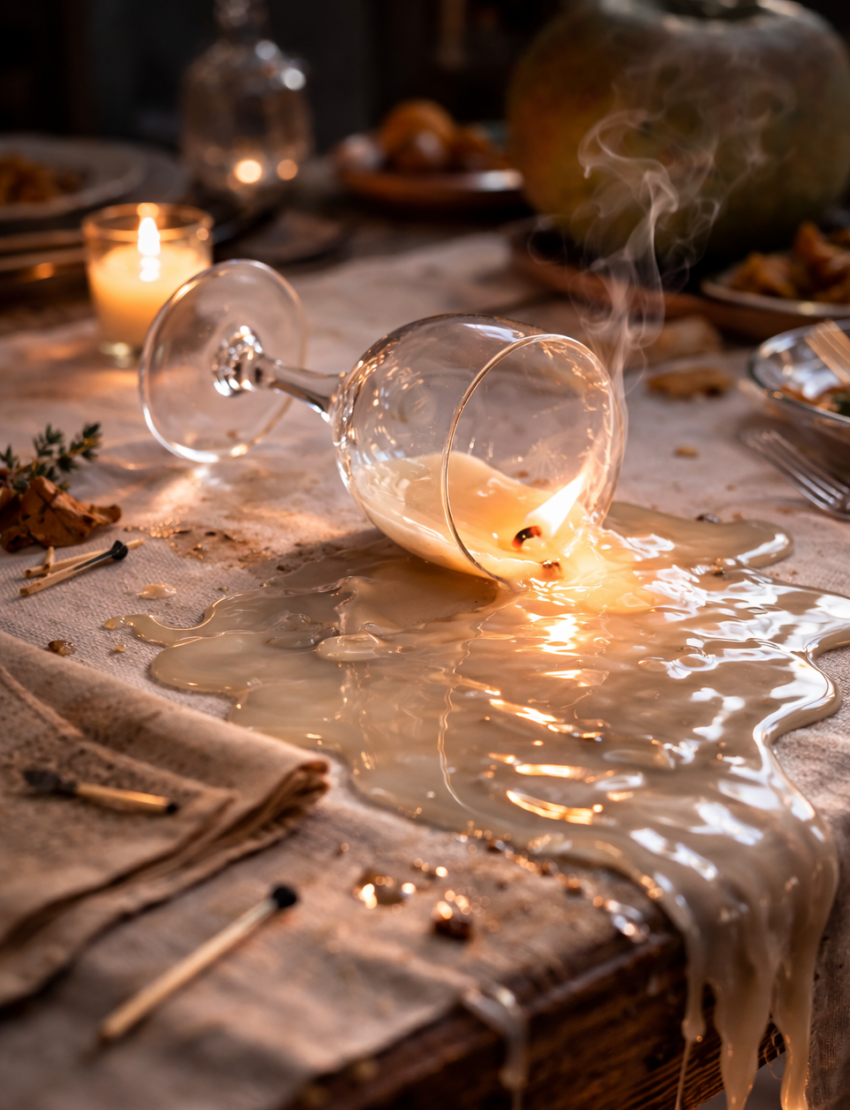
Stability is another frequently overlooked factor. Stemmed glasses have a higher center of gravity and a relatively small contact surface with the table. When serving beverages, this is manageable; when supporting an open flame, the context changes. Spilling wine is an inconvenience. Tipping over a lit candle presents a safety risk.
Can a candle be made in such a glass?
Technically – yes. The more important question is whether it is a structurally and safety-conscious choice.
Due to the tapered base, the difficulty of securing the wick, sustained heat retention in a vessel not designed for it, and reduced stability, stemmed glassware simply is not an optimal container for candle making. What appears elegant at first glance often requires structural compromises in practice, and in candle making, structural compromises are never minor details.